
RLSS Courses
Our RLSS-accredited pool-based training courses are designed to support lifeguards, swimming teachers, coaches, and leisure facilities in maintaining the highest standards of safety, competence, and regulatory compliance.
We deliver nationally recognised Royal Life Saving Society (RLSS) qualifications, including the National Pool Lifeguard Qualification (NPLQ) and the National Rescue Award for Swimming Teachers and Coaches (NRASTC). All courses are delivered by highly experienced, RLSS-approved trainers, ensuring training is practical, current, and aligned with industry best practice.
Our programmes support both initial qualification and ongoing professional development, helping individuals and facilities meet their operational, safety, and staffing requirements with confidence.
Courses We Offer
-
What is it?
The NPLQ is the most awarded lifeguard qualification in the UK and Ireland and is also internationally recognised.
More than 40,000 pool lifeguards qualify with the RLSS UK every year, and there are currently more than 80,000 pool lifeguards qualified in the NPLQ – 95% of all UK pool lifeguards.
This qualification is regulated in England by Ofqual, Qualifications Wales and CCEA regulation (Northern Ireland) and appears on the Regulated Qualification Framework as: The RLSS UK Qualifications Level 3 Award in Pool Lifeguarding Qualification number: 610/2603/7.
What is involved?
The NPLQ covers all elements of Pool Rescue Techniques, Lifeguarding Theory, First Aid and CPR. The course is physically demanding and will include swimming to set times, lifting casualties and diving to the deepest part of the swimming pool.
Training and assessment for the NPLQ are in three sections, and candidates must successfully pass all to attain the qualification.
Section 1 – The Lifeguard and the Law, Swimming Pool Supervision
Element 1 – The Lifeguard and the Law
Element 2 – Swimming Pool, Hazards, and Control Measures
Element 3 – Swimming Pool Supervision
Section 2 – Intervention and Rescue and Emergency Action Plans
Element 1 – Intervention and Rescue
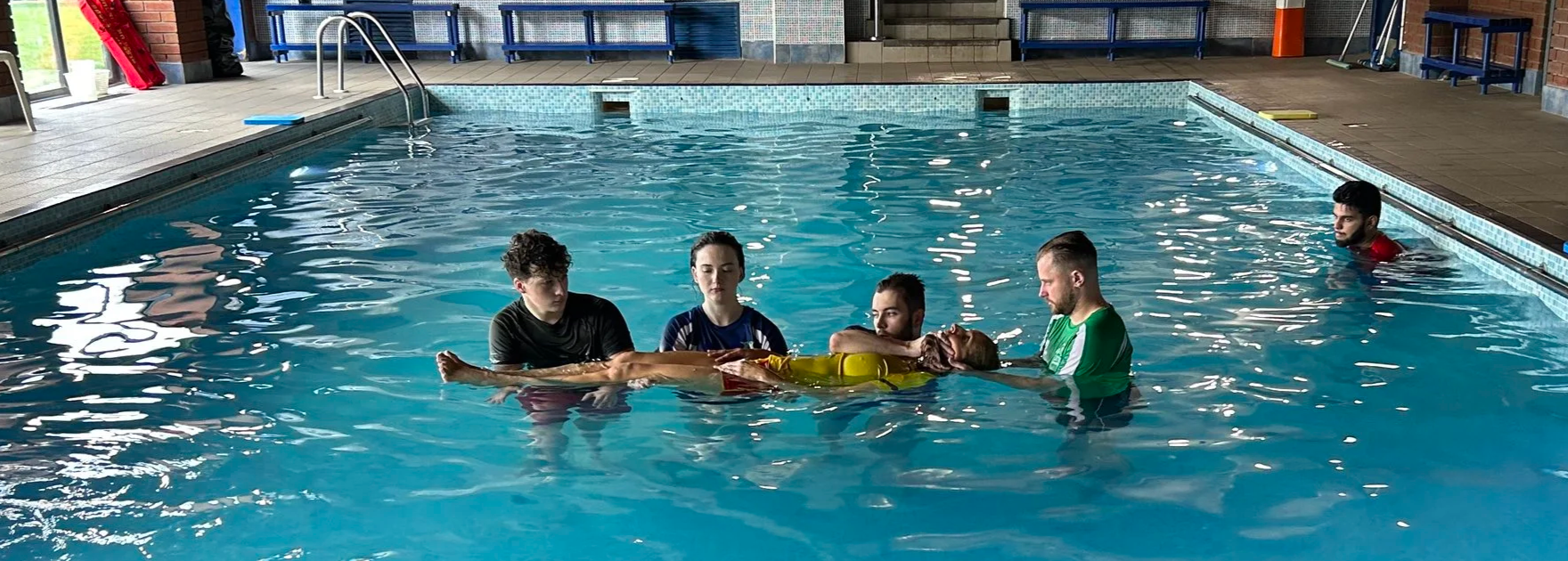
Element 2 – Rescue of a Casualty with a Suspected Spinal Injury
Element 3 – Emergency Action Plan
Section 3 – Cardiopulmonary Resuscitation, AED, and First Aid
Element 1 – Cardiopulmonary Resuscitation (CPR)
Element 2 – First Aid
Element 3 – Automated External Defibrillation (AED)
The Assessment
Assessment for the NPLQ takes place at the end of the course. It determines your knowledge and understanding of the principles of working as a pool lifeguard and assesses your ability to apply the skills and knowledge in a work-related environment.
The assessment is split into three sections:
Practical pool assessment
Theory Assessment for all three sections
Practical First Aid & CPR assessment
-
What is it?
National Rescue Award for Swimming Teachers and Coaches (NRASTC) NRASTC is a supervision and rescue award for swimming teachers, coaches and/or instructors working during programmed activities, such as swimming lessons. It is suitable for teachers working
in a wide range of swimming pools where the water is deeper than the teachers’ standing depth and meets the Individual sites risk assessment.
What is involved?
Section 1 – The Teacher, swimming pool and class management
Section 2 – Intervention rescue and emergency action
Section 3 - CPR & First Aid
The Assessment
Assessment for the NRASTC takes place at the end of the course. It determines your knowledge and understanding of the principles of working as a swimming teacher and assesses your ability to apply the skills and knowledge in a work-related environment. The assessment is split into three sections:
Practical pool assessment
Verbal Questioning Assessment for all three sections
Practical First Aid & CPR assessment
-
The Swimming Pool Emergency Rescue Award (SPERA) is a 2-day, trainer-assessed qualification designed for staff in hotels or small leisure clubs with shallow pools (approx. 1m depth).
It covers emergency action, cardiopulmonary resuscitation (CPR), first aid, and basic aquatic rescues. Candidates must be at least 16, capable of swimming, and able to surface dive to retrieve objects.
Key Aspects of the SPERA Course:
Purpose: Provides necessary safety skills for emergency scenarios where a full lifeguard (NPLQ) may not be required, but staff still need to manage risks, such as in small, shallow pools.
Course Content: The curriculum includes the role of the rescuer, pool safety operating procedures, emergency action plans, and practical rescue methods.
Assessment: The qualification is awarded based on a practical assessment of skills and knowledge, with 100% attendance required.
Prerequisites: Learners must be at least 16 years old, capable of swimming, and able to perform surface dives.
Validity: It is a non-regulated award intended for specific, smaller pool environments.
Differences from NPLQ:
SPERA is designed for specific, smaller, or shallow pools.
NPLQ (National Pool Lifeguard Qualification) is a more comprehensive, industry-standard qualification for professional lifeguarding in a wider range of pool environments.